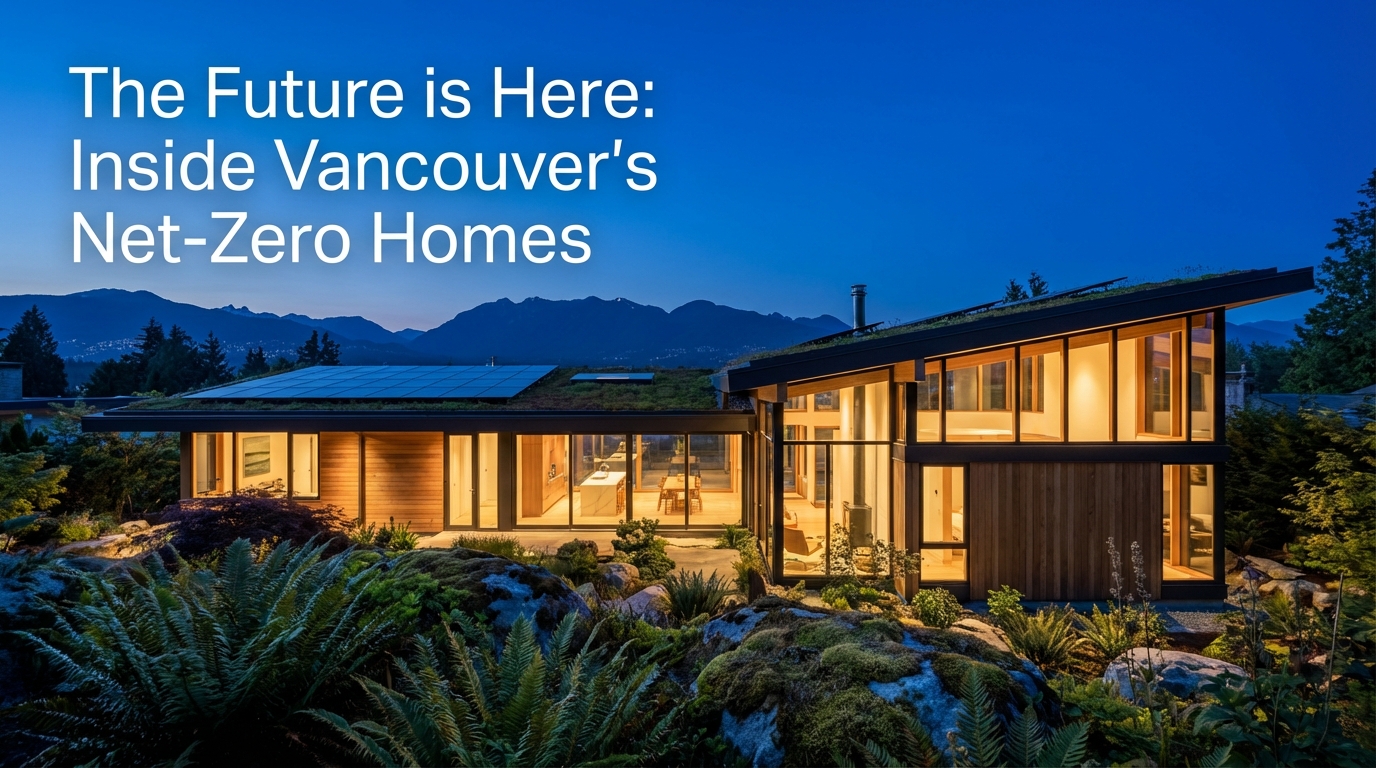
Why Net-Zero Is Now Mandatory in Vancouver
Vancouver’s buildings account for nearly 60% of the city’s total greenhouse gas emissions. That single statistic is driving one of the most aggressive climate action plans in North America: the city aims to be carbon-neutral by 2050.
Here’s the regulatory timeline that matters if you’re building a custom home:
| Date | Requirement |
|---|---|
| March 2025 | All new small residential buildings must meet the highest BC Zero Carbon Step Code |
| September 2025 | Vancouver Building By-law aligns with ZCSC Emission Level 4 (EL-4) for 1–3 storey homes |
| 2030 | Province targets Step 5 + EL-4 provincewide |
| 2050 | All existing buildings must reach zero-carbon performance |
What this means in plain language: if you’re building a new custom home in Vancouver, North Vancouver, West Vancouver, or the Sea-to-Sky corridor, zero-emission equipment for heating is no longer optional. All-electric systems — heat pumps for space heating and hot water — are now the standard.
Nobel Homes Insight: We’ve built 45+ Net-Zero and Near-Net-Zero custom homes across BC. The regulatory shift isn’t a surprise — it’s been coming for years. Builders who adapt early deliver better-performing homes at lower long-term cost.
What Makes a Home Net-Zero
A Net-Zero Energy (NZE) home produces as much renewable energy as it consumes over the course of a year. The result? Zero net energy bills and a carbon footprint approaching zero.
Every net-zero home is built on three pillars:
1. Ultra-High Performance Building Envelope
The envelope is where 80% of the performance happens. You’re sealing the home like a thermos:
- Superior insulation: R-40+ walls, R-60+ roof
- Triple-pane windows: U-factor ≤ 0.20
- Continuous air barrier: ACH50 ≤ 1.5 (air changes per hour at 50 Pascals)
- Thermal bridge-free construction details at all junctions
2. High-Efficiency Mechanical Systems
Once the envelope minimizes energy loss, efficient systems handle the rest:
- Heat recovery ventilation (HRV) or energy recovery ventilation (ERV)
- Air-source or ground-source heat pumps for heating and cooling
- Heat pump water heaters replacing conventional tanks
- LED lighting throughout + ENERGY STAR® appliances
3. Renewable Energy Generation
The final piece: generating what you consume:
- Rooftop solar PV arrays — Vancouver gets 1,800+ hours of sunshine annually
- Battery storage systems (optional but increasingly affordable)
- Grid-tied configurations with BC Hydro’s net metering program
- Smart energy management systems to optimize consumption
Net-Zero vs. Passive House
Many Vancouver homeowners confuse these two standards. They’re complementary, not competing:
| Aspect | Passive House | Net-Zero |
|---|---|---|
| Primary Focus | Minimize energy demand through design | Balance energy consumption with generation |
| Renewable Energy | Not required | Required (solar panels, etc.) |
| Heating Demand | ≤ 15 kWh/m²/year | No specific requirement |
| Air Tightness | ACH50 ≤ 0.6 | ACH50 ≤ 1.5 (typically) |
| Certification | Passive House Institute | Built Green, CHBA, Step Code 5 |